

As an Amazon Associate I earn from qualifying purchases. TinyNestKit is a participant in the Amazon Services LLC Associates Program, an affiliate advertising program designed to provide a means for sites to earn advertising fees by advertising and linking to Amazon.com.
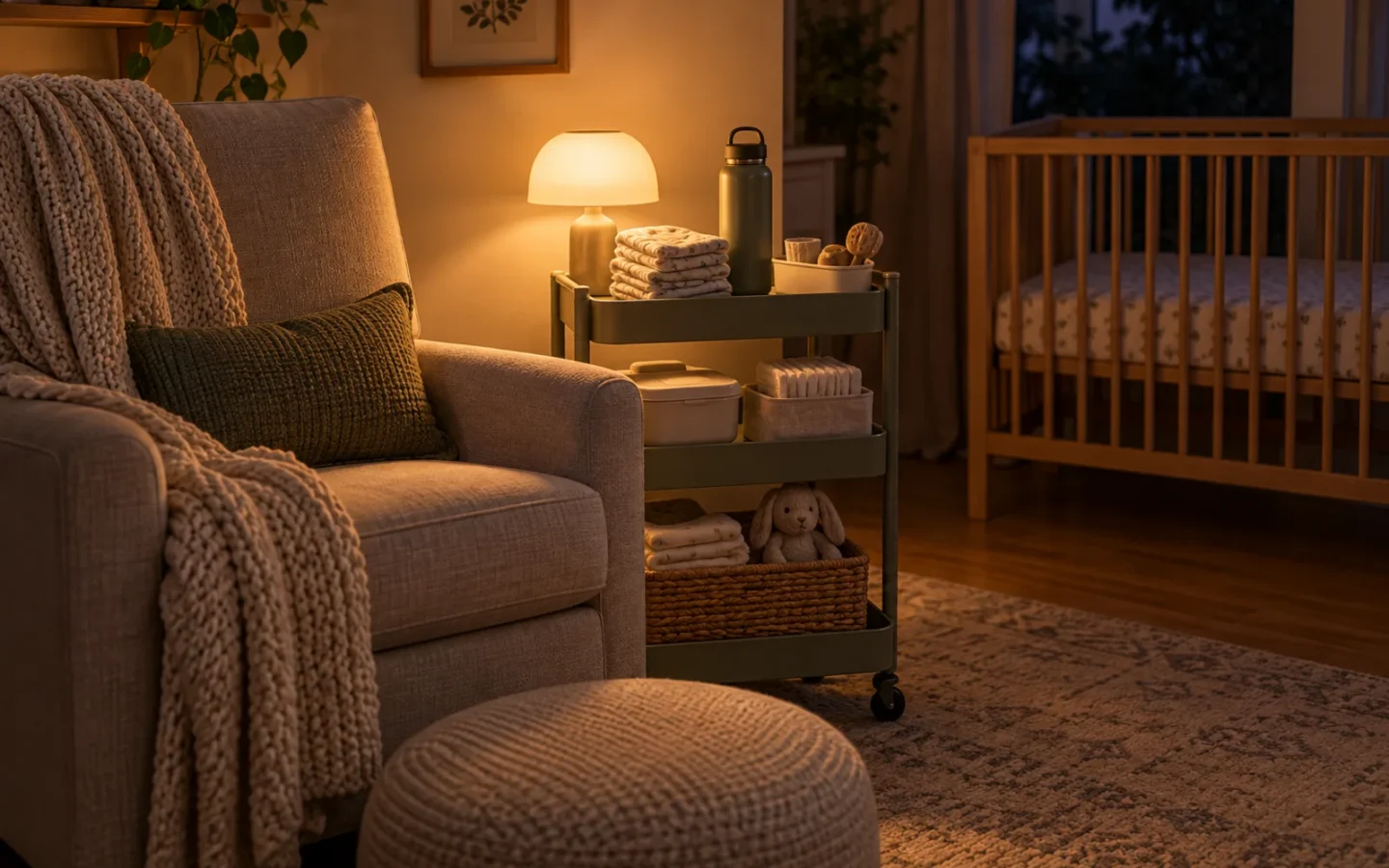
A night station should support the caregiver with low-glare light, water, burp cloths, and a clear seated path without encouraging unsafe sleep, improvised warming, or unrefrigerated preparation.
A night station should support the caregiver with low-glare light, water, burp cloths, and a clear seated path without encouraging unsafe sleep, improvised warming, or unrefrigerated preparation. In a small home, the safest organization usually reduces reaching, loose items, and reset steps instead of squeezing more objects into the room.
Follow current safe-sleep and feeding guidance from qualified health authorities. Return the baby to the approved sleep space; follow exact breastmilk or formula storage and preparation rules.
Protect the return-to-sleep path
Loose rugs, open drawers, and floor baskets become hazards when the caregiver is tired. The distinction matters because the visible symptom is often one step removed from the cause. Start with the mechanism and the rest of the decision becomes easier to audit.
Clear a direct path between sleep space and chair and add only secured dim light. Change one variable at a time and keep the first pass conservative. That gives you a comparison point and makes it easier to reverse course before damage or frustration compounds.
The route should work without stepping over any object. If that signal moves in the wrong direction, stop and return to the last known-good state. More product, pressure, height, heat, or time is rarely the best first correction.
Use low warm task light
Bright ceiling light disrupts everyone while darkness hides spills and latch problems. Treat this as a system rather than a shopping problem. Size, placement, material, routine, and the person or animal using it can all change what “good” looks like.
Place a dimmable warm lamp below eye level but beyond child reach. Prepare the entire path before starting: the work area, the tools, the cleanup, and the place where the item goes next. Interruptions are when shortcuts usually enter the process.
Hands and supplies should be visible without lighting the entire room. Judge the result after the system has settled, not only in the first few seconds. Early improvement can hide wobble, residue, fatigue, crowding, or a maintenance burden.
Keep hydration and cloths adult-side
Open drinks near electronics or the baby create spill risks. A useful recommendation has a boundary. It should explain not only why an approach works, but also the conditions that make another approach more sensible.
Use a closed water bottle and a small stack of washable cloths on a stable cart. Use the least aggressive method that can answer the question. Escalation should follow evidence from a small test, not impatience with the first minute of work.
Nothing should perch on the chair arm or crib rail. Use the check as a decision gate: continue only when the basic condition is stable. Otherwise, change the setup before buying an accessory meant to compensate for it.
Respect food storage times
A cart cannot make prepared milk safe at room temperature beyond guidance. This is where small constraints deserve more attention than headline specifications. The limiting detail is often access, clearance, stability, cleanup, or repeatability.
Use labeled timing and retrieve refrigerated items only through an approved plan. Write down the measurement or take a reference photo when memory would otherwise decide. A repeatable check is more useful than a confident impression.
Any uncertain bottle is discarded rather than guessed about. Do not average away an outlier that affects safety or comfort. One blocked exit, sharp edge, unstable joint, hot spot, or persistent mark can outweigh several convenient features.
Prevent dozing in unsafe places
Deep sofas and recliners can become dangerous if a caregiver falls asleep with a baby. The goal is not maximum intensity. It is a result that can be repeated without creating a second problem somewhere else in the routine.
Plan an alert seated feed and a safe handoff or support strategy. Build the routine around the difficult moment, not the ideal one. If a step is awkward when the room is busy or the item is wet, redesign that step now.
The baby returns to the approved sleep surface immediately after feeding. The best result is usually boring: predictable, easy to maintain, and clear about when it needs attention again. Novelty is not a substitute for control.
Reset before leaving
Used bottles and wet cloths contaminate the next feed when left in place. Good setup removes guesswork before it adds equipment. A clear baseline makes later changes legible instead of turning every adjustment into a new experiment.
Move used items to the washing zone and restock only clean dry supplies. Leave enough time to inspect the result under ordinary conditions. A setup that only looks right during installation has not yet passed a useful test.
The station should begin each night clean and uncluttered. When the evidence stays ambiguous, pause. A different tool, a professional assessment, or simply more observation may be cheaper than forcing a conclusion.
Record the baseline before changing more
Keep a short note of the starting condition, the exact setup, the order of work, and the first result you could verify. Include measurements, product dilution or settings when relevant, and a photograph taken from the same position and light. The note does not need to become a project log; it only needs enough detail to separate a real improvement from a change in memory, angle, weather, or expectation.
Set the next inspection by use and condition rather than an arbitrary urge to intervene. A stable setup may need only cleaning and a quick check, while a new noise, mark, wobble, odor, leak, behavior change, or loss of performance deserves an earlier look. Maintenance is most useful when it catches a small drift before the remedy becomes more aggressive than the original job.
Use the result to narrow the buying decision
Translate the successful setup into requirements before comparing listings. Write down the usable dimensions, material limits, access needed for cleaning, compatible consumables, and the one or two features that solved the original problem. Separate those requirements from conveniences and decorative details. This prevents a long feature list from displacing the physical constraint that made the equipment useful in the first place, and it gives you a direct reason to reject a product that cannot fit the routine.
Consider ownership after the first week as seriously as the unboxing. Check whether wear parts are available, whether the item can be disassembled without damage, where it will dry or be stored, and how failure becomes visible. Read the current manual and dimensions for the exact model because names and bundles can remain similar while specifications change. A slightly simpler product that can be inspected, cleaned, and used consistently is often the more durable recommendation.
When two options meet the basic requirements, compare the downside you would actually have to manage: extra floor area, a slower cleanup, recurring filters, a louder motor, more supervision, or a surface that wears sooner. Do not invent precision by ranking features that have no effect on this use case. The recommendation should remain conditional and easy to revisit when the space, user, animal, material, or routine changes.
Before committing to a purchase, verify the current model number, included parts, dimensions, warranty, return terms, and the latest manufacturer instructions. Marketplace titles and bundles change, so a familiar product name is not proof that a listing contains the same version described here. Keep the recommendation tied to the requirement it solves, and reject substitutions that remove a safety, fit, cleaning, or compatibility feature your setup depends on.
Recheck the setup after several ordinary uses. Look for the friction that appears only during cleanup, storage, refilling, charging, adjustment, or handoff to another person. If the routine consistently invites a shortcut, change the arrangement before adding more equipment. Long-term value comes from a tool remaining understandable and maintainable when the initial enthusiasm is gone.
A practical check before you finish
- Follow current product age, weight, and safety limits.
- Keep the sleep space completely clear.
- Anchor climbable furniture as directed.
- Store medicines and hazards locked away.
- Test the routine one-handed without holding a child.
- Reassess when mobility or development changes.
A product that fits this approach
A portable dimmable warm light can illuminate feeding tasks without using a harsh ceiling fixture.
VAVA VA-CL006 Nursery Night Light
Why we picked it
- Touch dimming supports low output
- Warm light reduces sharp contrast
- Rechargeable format avoids a floor cord during use
Reported drawbacks
- Charging adds a maintenance step
- Portable lights can be misplaced
- Must remain beyond child reach
The useful stopping point
The station exists to help an adult complete a safe sequence while tired: clear path, visible task, approved feeding practice, and prompt return to the sleep space.